| | Feature
Warsaw: A Microcosm Of Polish Jewry — Eighty-five Years Since the Erection Of The Wall Of the Warsaw Ghetto
by S. Cohen
Gesia Street in Warsaw after the war

The following is the fourth part of a four part article on Warsaw as a microcosm of Polish Jewry. In the first two parts, we learned about the prewar status of Warsaw as a major city of Polish Jewry. In Part 3 we learned about aspects of life in the ghetto. This is continued here.
For Part III of this series click here.
Part IV
Shechita in the Ghetto Years
When the war broke out in 1939, there were almost no sheilos relating to shechita of beheimos and ofos, as it was nearly impossible to find live chickens or animals in Warsaw. On erev Yom Kippur of 1939, the minhag of kapporos was abrogated. On October 26, 1939 a public notice from the authorities appeared forbidding shechita.
After the initial bombing stopped, live chickens and animals were found in Warsaw, but the prohibition of shechting still remained a problem. A clever idea served to counteract the prohibition. On the doors of the slaughterhouses, the shochtim hung a sign in Polish: "Non-Jewish slaughtering." They bribed the local Polish police not to reveal their identity.
Finally, they placed an example of a non-Jewish chicken in the front of the slaughterhouse to confuse any unexpected visitor. Often Polish policemen from distant neighborhoods visited the slaughterhouses and found the Jewish shochtim. The shochtim were forced to pay them heavy bribes so that they wouldn't report them to the Gestapo.
When the ghetto in Warsaw was sealed off, the shochtim stopped regular shechita as they could not bring in many live chickens to the ghetto because of the overcrowded conditions. Also, they could not bring the chickens into the slaughterhouses of the Poles outside of the ghetto as it would be stolen or reported to the Gestapo. Individual shochtim attempted, with great mesiras nefesh, to continue shechita on a very small scale in clandestine areas in order that kosher chicken be made available at least on Shabbos and Yom Tov.
Shechting beheimos in the war before the closure of the ghetto was done in secrecy, usually in the middle of the night. Shochtim hid the beheimos in remote villages and would perform the shechita in a forest or other deserted area. As soon as the meat was ready for distribution, it was hid underneath piles of wood and vegetables. At this point, some shochtim felt they had to stop shechita because if the shechita was done in a moment of fear, it was not really kidas vikadin. Others felt that if the meat could not be sold with nikur (for fear of being found out), then it was also not right to sell it at all.
Once the ghetto was closed, shechita of animals stopped entirely as it was not possible to bring animals into the ghetto. A few months later, the shochtim devised a plan to continue shechita of animals on a very small scale.
A shochet who wanted to leave the ghetto disguised himself as a Pole and paid a fee of fifteen coins to join the group of Jewish laborers leaving the ghetto: the platzovniks. This group of platzovniks smuggled out the shochet to a slaughterhouse of a bribed Christian. The next problem was to find an area behind the slaughterhouse which was totally clear of treif meat. (This in itself presented many complications).
Then, the shechita would be performed and the meat had to be carefully wrapped up beneath layers of assorted goods so as not to arouse the suspicion of the Polish police who might identify the Jew. At times, the shochet could not return to the ghetto for weeks when he sensed the Gestapo lurking on the nearby roads and he then slept in villages near Warsaw.
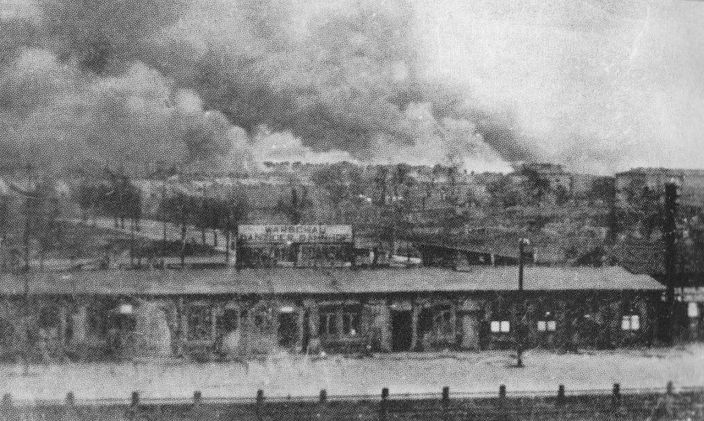
The Warsaw ghetto in flames
Shabbos, Pesach, Yom Kippur
"Erev Rosh Hashana, 5701. October 2, 1940. We have no tefillah betzibbur even on the yomim noraim," writes one frum Jew whose diary was found buried in the ground after the war. "There is darkness in our Shuls, for there are no mispallelim — silence and desolation within and sorrow looking on from without.
Even for the yomim noraim, no permission was granted for communal worship. I don't know whether the Judenrat made any attempt to obtain it, but if they did not try, it was because everyone knew in advance that the request would be turned down. Even in the darkest days of our golus we were not tested with this trial. Never before in our history was there a government so evil that it would forbid an entire people to pray. But never before in our history, drenched in tears and blood did we have so cruel and so barbaric an enemy...."
"Secret minyanim by the hundreds are organized throughout Warsaw and do not skip even the longest niggunim in the tefillah. There is not even a shortage of droshos. Everything is in accordance with the old minhagim. When there is no malshin, the enemy does not know what is going on, and we can assume that no Jewish man would be malshin on Jews standing before their Creator in tefillah.
"They pick an inside room whose windows look out onto the courtyard, and pour out their supplications before Hashem Yisborach in whispers. The tefillos are heartfelt; it is possible to weep in secret too and the gates of tears are not locked. And so, we give praise to Hashem `shehechiyonu vikiyimonu vihigiyonu lazeman hazeh!' During the year, many individuals drank the cup of hemlock; many have gone to their graves, the community has been debased and impoverished. But still, it exists."
Two years later, the same Jewish sufferer describes the yomim noraim in the ghetto.
"October 10, 1941. A hint of the netzach Yisroel ... that's how we saw the opening of our shuls on Yom Kippur. Three shuls opened their doors for tefillah: The Big Shul on Tlomackie Street, the Nozid Shul on Twarda Street, and the shul on Dzielna Street. This was officially done through the Judenrat. There was nothing to prevent arranging a minyan in every house. Every minyan was filled to capacity, each one sought the religious atmosphere, each one had to pour out his heart to his Maker."
"October 13, 1941. The eve of Shemini Atzeres, 5702. Now on this Shemini Atzeres, we have gathered again in a meeting of comrades in suffering to observe the precept `vihoyiso 'ach somayach.' We offered divrei chizuk one to another and tried to strengthen our emunah: just as we have withstood everything up until now, so shall we continue to withstand all that may yet occur until better days return...."
On September 7, 1942, all Jews still alive in the ghetto were ordered to assemble at the Umschlagplatz for "selection." Hillel Zeitlin, a famous writer and baal teshuva arrived at the Umschlagplatz wearing his tallis and tefillin and carrying a sefer Torah. On erev Rosh Hashana, he spoke inspiring words to the entire tsibur at the Umschlagplatz, encouraging them to strengthen themselves in emunah and daven. Shortly afterwards, he was sent to Treblinka.
Keeping Shabbos in the ghetto became virtually impossible, as the Germans forced them to work. The Germans forced the Jewish stores inside and outside of the ghetto to remain open on Shabbos. Although bentching licht was forbidden, many frum women continued to bentch licht in secret cellars. As their eyes streamed with tears they managed to whisper the brocho.
In the same cellars, secret minyanim were held on Friday evening after midnight, where Yidden would reminisce about Shabbos in Warsaw before the war and offer each other divrei chizuk. In those same cellars, one could also find sifrei Torah which had been salvaged from the initial bombing in 1939 and subsequent destruction of shuls. As sifrei kodesh were sold on pushcarts in the ghetto (remnants of personal belongings discarded by the Germans), many cellars possessed a substantial amount of seforim.
Pesach in the ghetto was accompanied by an endless trail of sheilos and difficulties. In prewar Warsaw, the rabbonim would arrange a shtar mechiras chometz, but once the ghetto was closed, not one single non-Jew lived there. The rabbonim searched the ghetto, but it was in vain. Finally, one of the Jewish laborers leaving the ghetto devised a plan to arrange the mechirah with a Christian artisan on the Aryan side and the mechirah was consummated.
After Pesach the rabbonim encountered sheilos of all sorts: what should be done with a loaf of black bread found in the ghetto that a Jew didn't sell in the mechirah at a time when starvation was rampant?
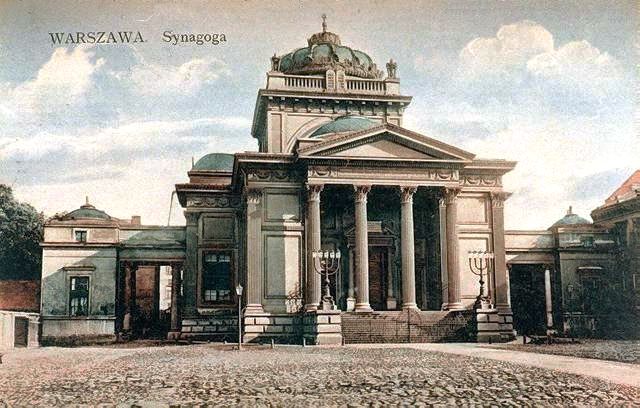
The Wielka synagogue in Warsaw
The Av Beis Din of Piessestna; Rav Klonimus Kalmish Shapiro
Rav Klonimus Kalmish, the Av Beis Din of Piessestna, Hashem yikom domo gave many droshos in the Warsaw ghetto and maintained the spirit of the suffering Yidden there. Rav Klonimus was a very great talmid chochom and his tzidkus was legion.
Before the war, Rav Klonimus began writing his seforim: Tzav Zeiruz, Hachshoras Havreichim, Mavo Hashearim, Derech Hamelech, Bnei Machshava Tova and Chovas Hatalmidim. Some of his works were published in Warsaw. Aish Kodesh is his collection of droshos, most which were said in the Warsaw ghetto to awaken people to do teshuva and be mischazeik in tefillah in the turbulent times.
As the tragedies in the Warsaw ghetto intensified, Rav Klonimus realized that his fate was unknown and his seforim might be lost forever. He took his seforim and packed them into a milk canister and attached a letter to anyone who would find the writings. Years later, a Polish worker was digging on that very spot to erect a building in Warsaw. He found them and turned in the manuscripts to the Jewish Historical Archives in Warsaw.
In the late 1940's they were retrieved by a Jewish traveller in Poland and sent to Eretz Yisroel (as Rav Klonimus requested in his letter) and then his seforim were published.
These are the exact words of his tzavoa: (originally written in Yiddish and later translated into Hebrew by those who published the seforim).
"Oifmerkzam!! Ich hobb dem kavod mir tzu erloiben tzu behten dem giherten herrer,...."
"Attention!! Boruch Hashem I have the honor to allow myself to request from the honorable individual, or honorable institution, which will find my writings Hachshoras HaAvreichim.... in his goodness to bother to send them to Eretz Yisroel to this address (his nephew): HaRav Yeshaya Shapiro, Tel Aviv, Palestine, and please include the following letter for him. As Hashem Yisborach will be merciful, if I will be left with the Jews surviving the war, I request to return these writings to the Rabbinate in Warsaw for Klonimus. And Hashem Yisborach will be merciful on us, she'eiris Yisroel that is in each and every city and save us and give us life and save us kiheref ayin. With great thanks from the depths of my heart. Klonimus."
Rav Klonimus attached a letter to his nephew Rav Yeshaya Shapiro asking him to publish his seforim (if they indeed reached him). These are selected sentences from his letter...."This work Hachshoras HaAvreichim I began printing before the war, but stopped as the war broke out, and now that we are in terrible danger each day, I beg of you my dear one, when these seforim arrive to you, try to print them and distribute them in Klal Yisroel.... In the sefer Hachshoras HaAvreichim I wrote an azkara for my wife the tzadeikes, but now my other family members were taken so please include an azkara for my mother, my martyred son, my martyred daughter-in-law ....
"Hashem should have mercy and say "enough" of Klal Yisroel's suffering, and my personal suffering, and return to me my precious daughter the tzanua Rachel Yehudis who was snatched away from me on Rosh Chodesh Elul 5702.... The words of your relative who is shattered from my tzoros and Klal Yisroel's tzoros which are as deep as the fathoms of the ocean.... Klonimus."
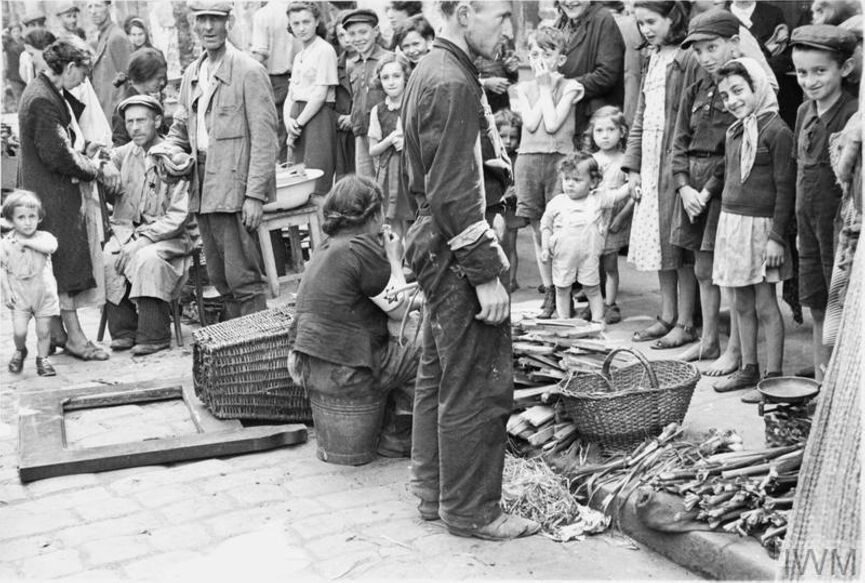
The Warsaw ghetto vegetable market
Deportations
The next phase in the Final Solution was deporting the remaining Jews in the ghettos to Nazi death camps. On June 1, 1942, the Treblinka death camp was opened. In Treblinka Jews would be gassed to death in small gas chambers which were operated by diesel engines.
On July 22, 1942, the first deportations took place. A specially trained SS unit, called Sonderkommando was employed to carry out the deportation from the ghettos to the death camps. Adolf Karl Eichmann, the SS Obersturmbannfuhrer in the Main Reich Security Office in Berlin, directed the deportation and extermination. In Warsaw, Hans Hofle, SS Hauptsturmfuher dictated orders to the Judenrat on 26 Grzybowska Street concerning the deportation.
When a few people found out what the deportations meant, they tried building underground cellars or hiding underground. But the Nazis came with bloodhounds to find the buried Jews who were still alive. On January 18, 1943, the Germans launched the second wave of deportations. They invaded the Warsaw ghetto and carried off the inhabitants to Treblinka.
Some Jews tried to escape through the sewers but eventually many were killed when bombs fell on Warsaw and the streets were gassed. The Christians offered to save the three remaining rabbonim of Warsaw, including Rav Menachem Zemba, but he declined the offer and was niftar al kiddush Hashem.
By April or May 1943 the last survivors of the ghetto were found in underground bunkers. Warsaw was set up in flames and the entire ghetto was demolished. General Stroop radioed in to Hitler: "Is gibt keinen judischen Wohnbezirk in Warschau mehr!" There is no Jewish quarter in Warsaw anymore!
"And it was after the Churban..."
HaRav Eliyahu Eliezer Dessler, zt'l refers to the churban in Europe in various places in his seforim Michtav MeEliahu. In one shiur he gave he speaks to his talmidim about learning from the churban. (This letter is called Vayehi Acharei Hachurban). Here are selections.
"...pay attention my dear sons, our generation is not as every generation,... we are the generation of the churban! We cannot even fathom in part what was truly lost... the richness in spiritual life, the atmosphere of a Yeshiva, the aspirations for shleimus, the lomdus, the yiras Shomayim, the heartzigkeit in avodas Hashem... all is lost! Those kedoshim went to the world of peace, to a place where the churban will no longer reach them... Vayehi Acharei Hachurban ... Why were we left alive? Why did Hashem save us? We are the she'eiris hapleita... Our lives must be only to build upon the ruins, to revive the kedusha. True mesiras nefesh is needed! True! Not imaginary or partial! Let us build ourselves, our children, our mosdos Torah! Let us build yeshivos! Let us return fathers and sons to Torah! Let us work hard and Hashem will send us hatzlocho! Let us be mischazeik..."
Hashem yikom domom.
|